AlphaOracle: Deciphering Oracle-Bone Script
An AI system that deciphers oracle-bone script the way a paleographer does — morphology, context, and philology, fused into a verifiable evidence chain.
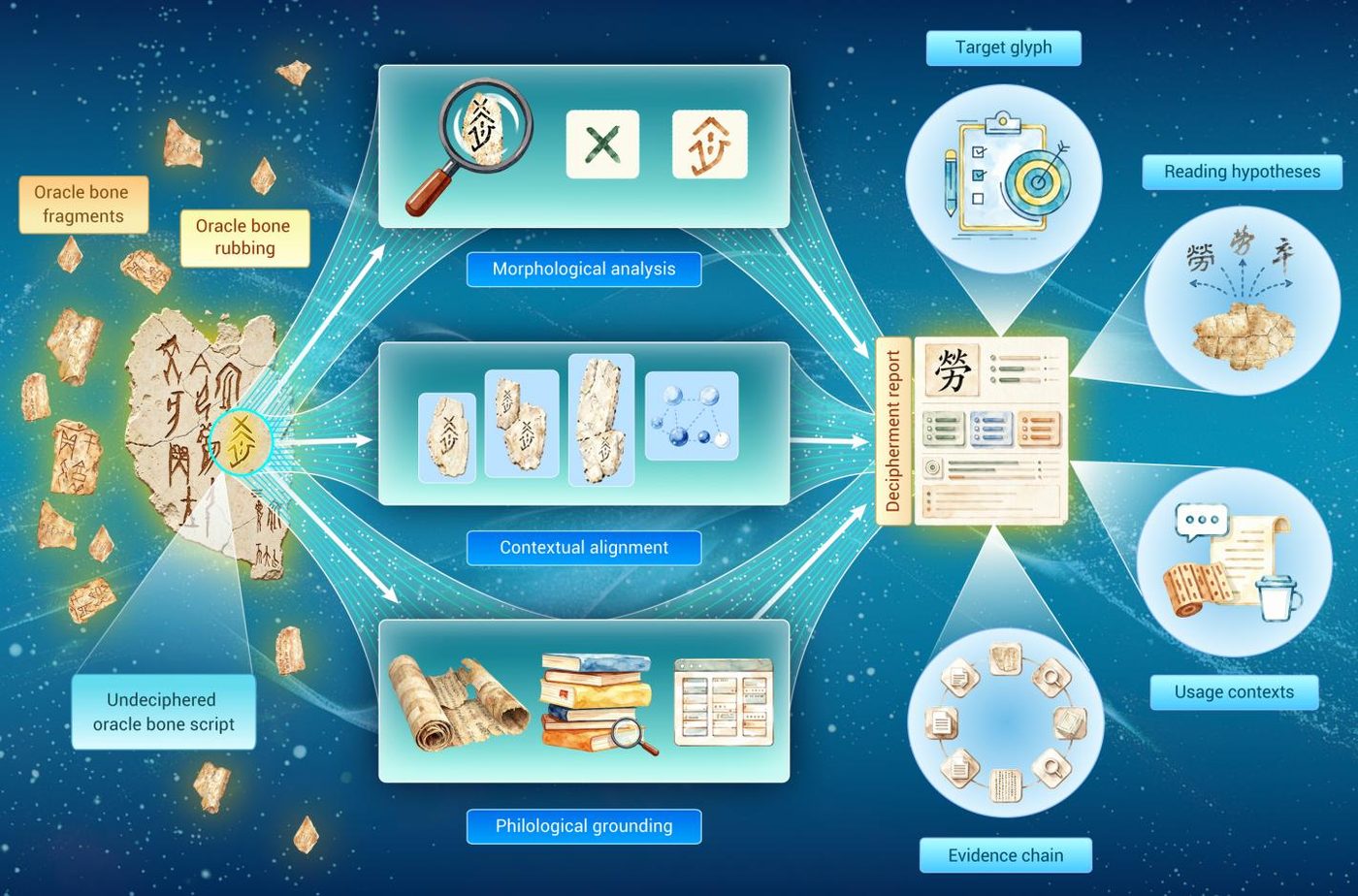
Three-thousand-year-old oracle-bone script still hides nearly three thousand undeciphered characters. In a study published in The Innovation, a joint team from Huazhong University of Science and Technology, South China University of Technology, and Anyang Normal University introduces AlphaOracle — an AI system that emulates how a human paleographer actually works: it first traces how a glyph evolved, then checks how the character is used in real inscriptions, and finally cross-references transmitted texts and modern scholarship, producing a decipherment report that experts can verify step by step.
Why is oracle-bone decipherment so hard?
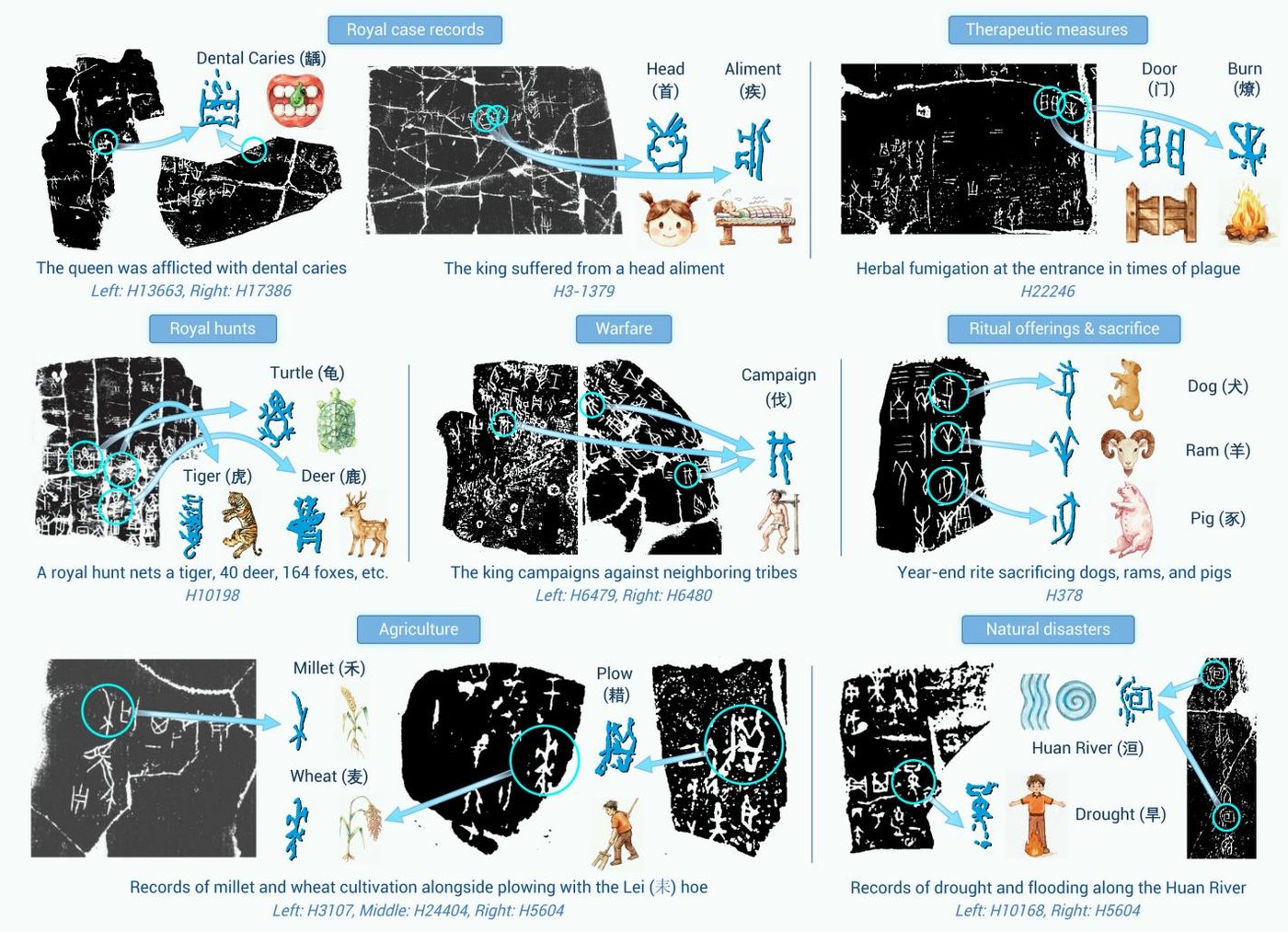
Oracle-bone script emerged in the late Shang dynasty (c. 14th–11th century BCE), recording royal divinations about hunts, illness, agriculture, disasters, and sacrifice. More than 150,000 excavated pieces preserve at least 4,500 distinct characters, yet only about a third have been reliably deciphered; roughly 3,000 remain unread. These characters are sparse in usage and often physically damaged, and the script carries no phonetic cues — so decipherment has long depended on the cross-disciplinary judgement of a few experts in palaeography, exegesis, and philology. That makes it hard to scale and hard to reproduce.
Why earlier AI fell short
Most prior AI work stopped at retrieving and classifying already-deciphered characters. It read form but not meaning: candidates were proposed from visual similarity alone, without corroboration from usage or literature. That offers little help on the unread characters, and gives paleographers little reason to adopt it.
AlphaOracle: walking the expert's workflow
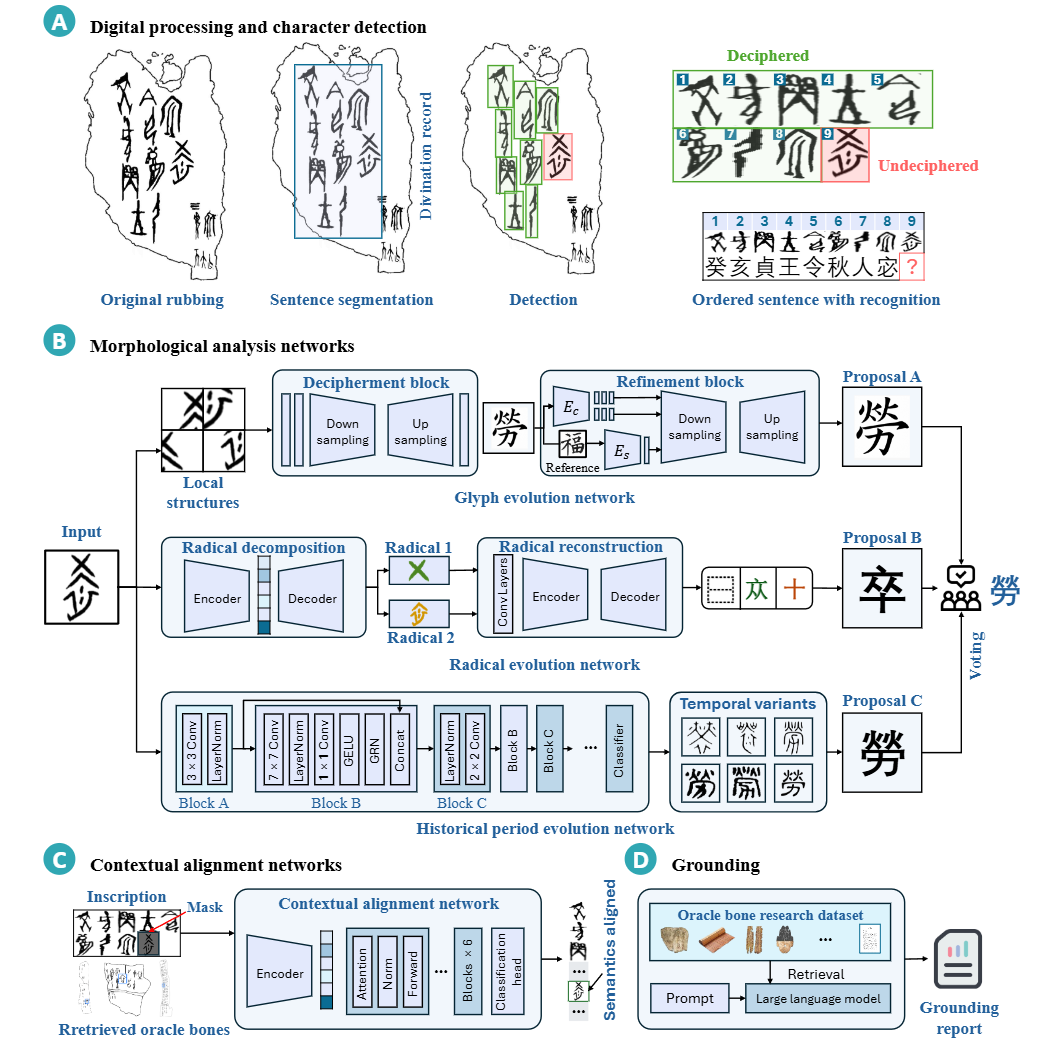
Inspired by the workflow paleographers have refined over decades, AlphaOracle decomposes that multi-step reasoning into computable, traceable stages. A rubbing-parsing module first digitises the broken bone and sorts characters into deciphered and undeciphered, after which reasoning proceeds along three complementary lines of evidence:
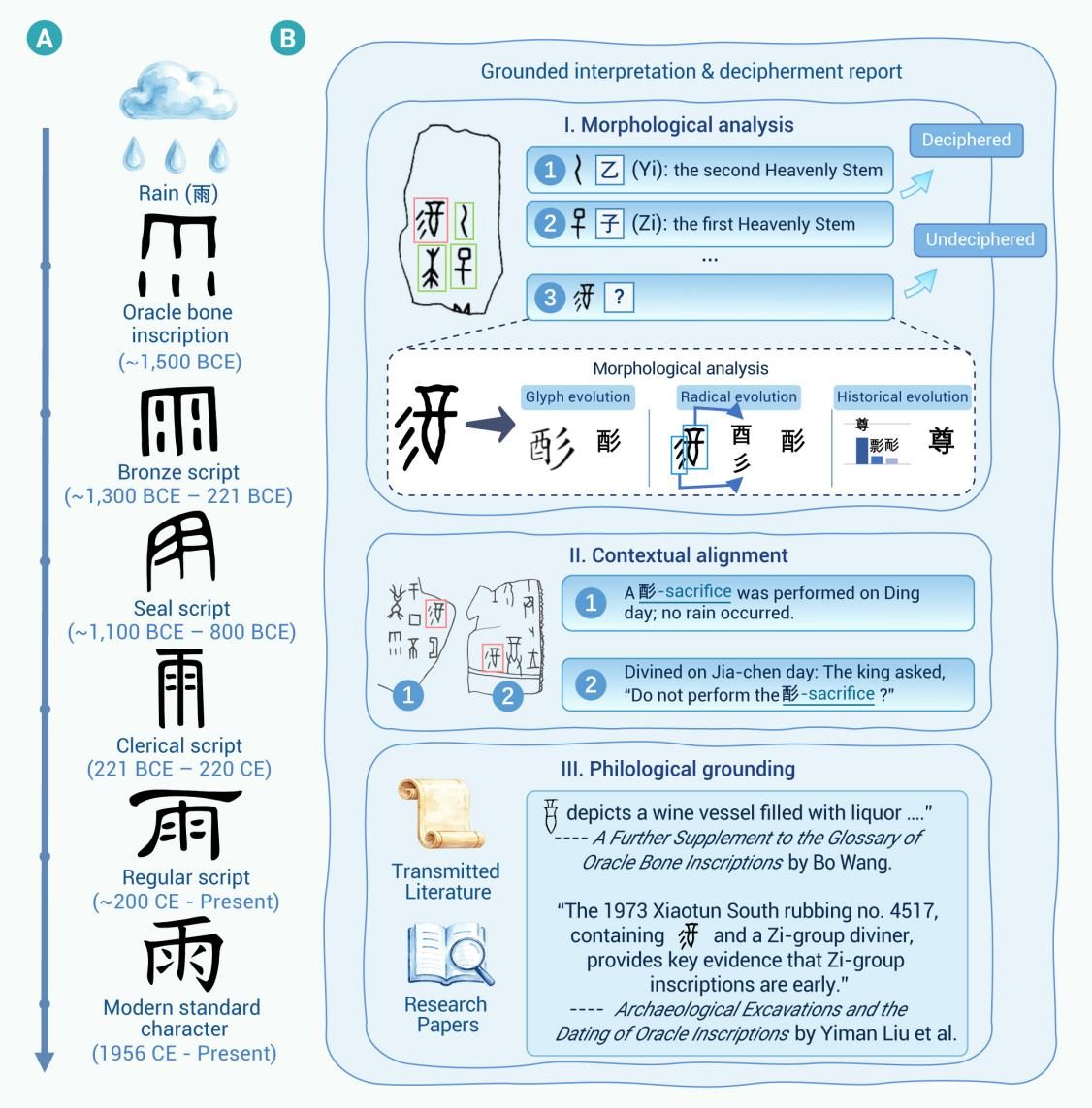
- Morphological analysis — an ensemble of three expert models (glyph-diffusion, radical decomposition-and-reassembly, and cross-era evolution) models the form changes across oracle-bone → bronze → seal → clerical → regular script, proposing modern-character candidates with confidence scores.
- Contextual alignment — a BERT-style masked language model retrieves every occurrence of the target character across large corpora of rubbings and hand-copies, analysing co-occurrence, usage, and set phrases to judge how plausible each candidate reading is in real context.
- Philological grounding — across 25 transmitted works (e.g., Shuowen Jiezi and the Guwenzi Gulin) and more than 23,000 modern studies, evidence is retrieved by both form and meaning, weighted by date, source authority, and genre, yielding a citable evidence package for each candidate.
The three lines are not a simple vote but a progressive tightening: morphology proposes candidates, context re-ranks them, and philology checks them against external evidence — culminating in a decipherment report that experts can deliberate over, with the source and confidence of every step laid out.
The largest oracle-bone digital resource to date
Underpinning the pipeline is the largest digital oracle-bone resource assembled so far: 73,000 rubbings, 45,000 scans, and over 23,000 research papers. Rather than looking at one image, the system searches as wide a material pool as possible for same-form, near-synonym, co-occurrence, and later-literature clues — reorganising evidence once scattered across separate books, databases, and papers, so its output is not a single point estimate but a source-traceable explanation.
Results
On simulated decipherment of genuinely unread characters, AlphaOracle leads across the board. Glyph prediction reaches 23.1% Top-1, clearly ahead of image-generation baselines such as SR3. Contextual restoration reaches 56.1% (vs. 22.2% for Gemini 2.5 Pro), with candidate re-ranking at 95.2% vs. 65.4%. Full-sentence interpretation scores 0.491 / 0.586 / 0.659 on BLEU / ROUGE / METEOR.
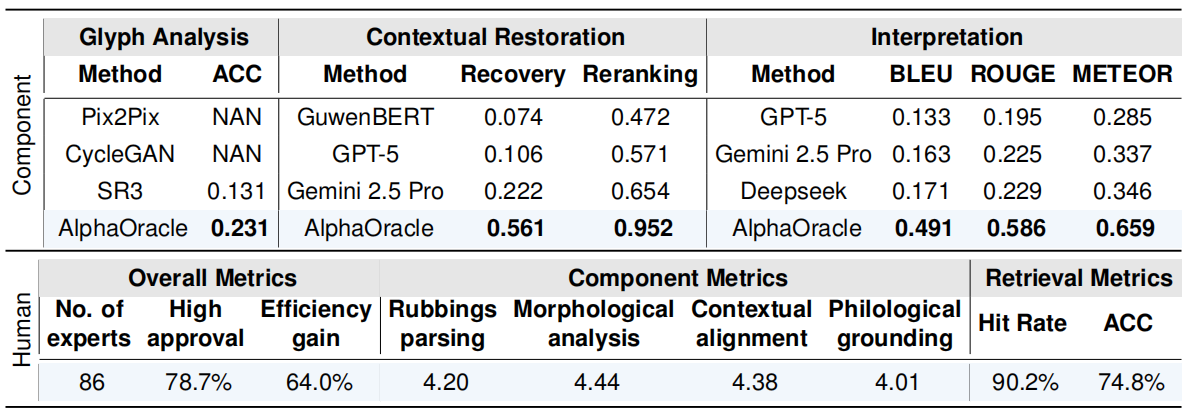
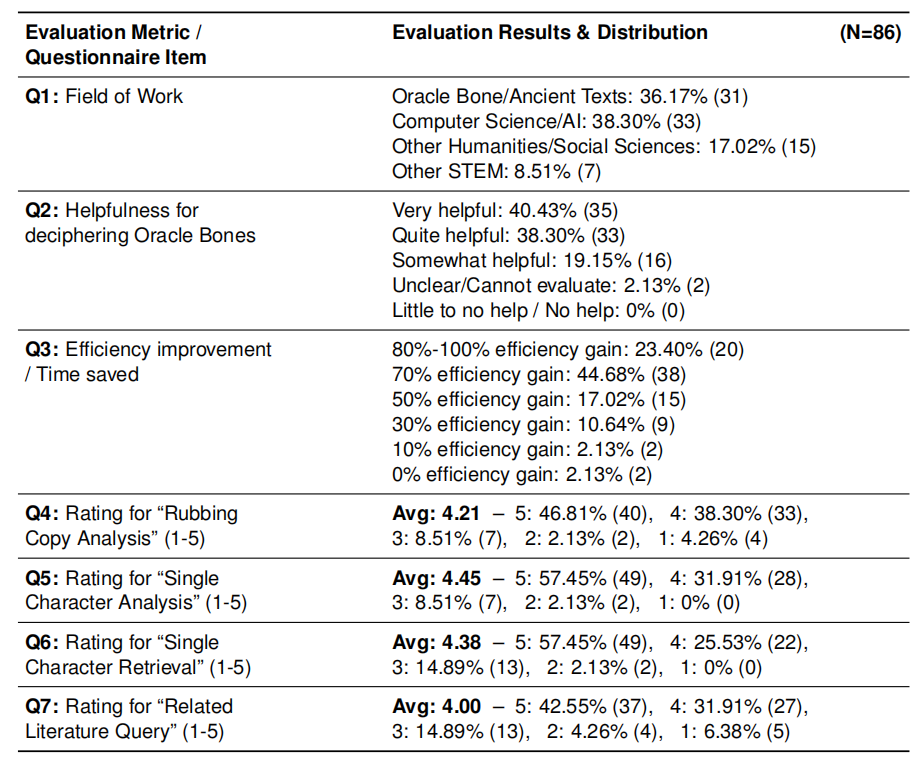
Eighty-six experts in oracle-bone studies, palaeography, and AI evaluated the system anonymously: more than three-quarters rated it very useful or useful, and estimated it would save about 64% of research time on average.
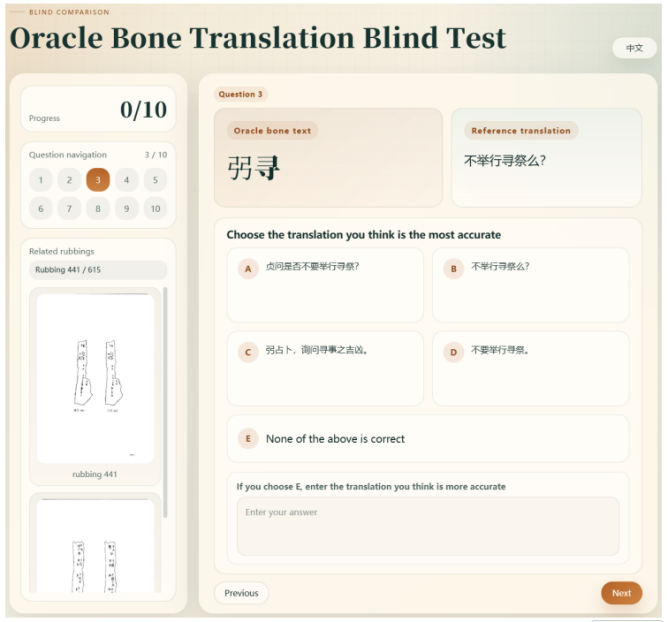
In a Turing-style blind evaluation, 21 senior oracle-bone scholars compared anonymised readings; AlphaOracle won the top preference rate at 45.2%, ahead of GPT-5, Gemini 2.5 Pro, and DeepSeek.
Case study: a new reading of the long-debated character 勞
The oracle-bone character 勞 has long carried two readings — a clan/place name, or an adverb marking completion. AlphaOracle combines all three layers of evidence: its three-model morphology ensemble supports the 勞 reading; across ten similar inscriptions the character is used consistently in place/clan-name structures such as divining at 勞; and sixteen studies (including Qiu Xigui's On 毕 and Pan Yunzhong's work on the Chinese basic lexicon) corroborate one another. For the Tunnan-307 rubbing, AlphaOracle re-reads 令秋人宓勞 as order the Qiu clan to pacify the territory of Lao — surfacing a micro-record of frontier governance in the Shang state. The conclusion has been adopted by an authoritative academic database, and the system supplies systematic arguments for 22 further contested variant characters.
Scope & limitations
AlphaOracle depends on enough digitised material, comparable contexts, and a verifiable body of literature. Where a character appears very rarely, lacks comparable context, or has no follow-up scholarship, its help is limited. It is therefore not a universal solver for every unread character, nor a replacement for the long-trained oracle-bone scholar — more precisely, it is a faster, more transparent assistive framework built on top of the expert workflow. For other ancient-script research that likewise needs form analysis, contextual comparison, and multi-source verification, the same approach may offer a transferable methodology.
Outlook
AlphaOracle moves ancient-script decipherment from reading by eye toward multi-source evidential reasoning — see the form, read the context, check the literature. It does not aim to replace experts, but to gather evidence scattered across studies, museums, and vast literature efficiently in front of the scholar, so that every reading is accountable and traceable to its source. The team has open-sourced the full code, model weights, and an online demo. Looking ahead, this expert-workflow-plus-evidence-chain paradigm may offer a methodological reference for other undeciphered scripts — such as Maya and Proto-Elamite — and for digital humanities and cultural-heritage preservation more broadly.